Redshift
In this section, we introduce Amazon Redshift Spectrum as the next analytical option after Athena for querying curated data in the data lake.
Amazon Redshift Spectrum extends Amazon Redshift so that SQL queries can access data stored directly in Amazon S3. In this workshop, Spectrum works together with the AWS Glue Data Catalog, allowing Redshift to understand external tables without requiring the dataset to be fully loaded into warehouse storage first.
Why Redshift Spectrum Matters
Athena is excellent for quick, serverless exploration. However, many analytics teams also need a warehouse-oriented environment for broader SQL workflows, shared query tools, and integration with downstream BI platforms.
Redshift Spectrum helps bridge that gap by combining:
- Warehouse-style SQL analysis
- Direct access to S3-based data lake files
- Metadata reuse from AWS Glue Data Catalog
- Integration with reporting and BI tools
Redshift Spectrum does not replace the Glue pipeline. It consumes the processed outputs and catalog metadata created earlier in the workshop.
How Redshift Spectrum Fits in This Workshop
The following diagram shows how Redshift Spectrum fits into the workshop architecture and query flow:
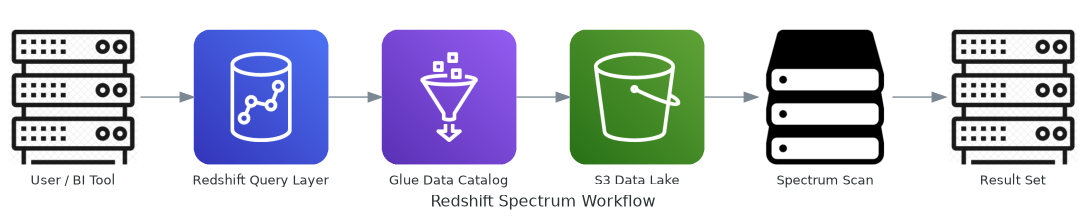
This means:
- Amazon S3 remains the storage layer
- AWS Glue Data Catalog provides schema and table metadata
- Redshift Spectrum queries the external data through Redshift SQL interfaces
What You Will Do in This Section
In the hands-on steps that follow, you will:
- Review the core concepts behind Redshift Spectrum
- Set up Amazon Redshift Serverless
- Connect to Query Editor v2
- Create an external schema linked to the Glue Data Catalog
- Query the Glue-managed external tables from Redshift
- Review common mistakes, cost considerations, and cleanup guidance
Benefits of Using Redshift Spectrum
| Benefit | Explanation |
|---|---|
| External Querying | Query S3 data without fully loading it into Redshift tables |
| Glue Integration | Reuse discovered schema from the Data Catalog |
| Familiar SQL Experience | Use Redshift query tools and warehouse-style workflows |
| Scalable Analytics | Support larger analytical workloads across curated datasets |
| BI Readiness | Prepare data access patterns that connect naturally to reporting tools |
Redshift Spectrum and Athena
Athena and Redshift Spectrum both query data in Amazon S3, but they are usually used in different situations:
- Use Athena for lightweight, direct, ad-hoc SQL analysis
- Use Redshift Spectrum when you want a more warehouse-oriented analytics workflow
- Use QuickSight when you want dashboards and visual storytelling from analytical results
Together, they show how the same curated dataset can support multiple consumption patterns.
Learning Outcome
After completing this section, you should understand:
- What Amazon Redshift Spectrum is
- How it integrates with Amazon S3 and AWS Glue Data Catalog
- Why it complements Athena in the BI layer
- How Redshift Serverless can be used to query curated data lake outputs