Data Pipeline with AWS Glue
Contents
Executive Summary
Summary:
This project aims to build an automated Data Analytics Pipeline on Amazon Web Services (AWS) using a Data Lakehouse architecture. The system is designed to process large-scale New York Yellow Taxi trip record datasets through data ingestion, metadata management, ETL processing, data warehousing, and visualization workflows.Objectives:
- Build a Data Lake system on Amazon S3.
- Automate ETL and data processing workflows.
- Automatically manage schema and metadata.
- Clean and standardize data before analytics.
- Support direct SQL querying on S3 using Amazon Athena.
- Build a Data Warehouse for OLAP workloads using Amazon Redshift.
- Create interactive dashboards using Amazon QuickSight.
- Establish monitoring and security mechanisms for the entire pipeline.
Scope:
- Build a Data Lake on Amazon S3.
- Implement workflow orchestration using AWS Step Functions.
- Use AWS Glue Crawler, AWS Glue Data Catalog, and AWS Glue ETL Job for metadata management and ETL processing.
- Integrate Amazon Athena, Amazon Redshift, and Amazon QuickSight for analytics workloads.
- Configure Monitoring & Security services using IAM, CloudTrail, CloudWatch, and SNS.
Problem Statement
Current Challenges:
The Yellow Taxi dataset contains a massive amount of continuously growing trip data. However, raw data contains multiple issues that negatively impact analytics quality:
- Missing or invalid values:
passenger_count = nulltrip_distance = 0fare_amount < 0
- Unstandardized schema across datasets.
- Difficulties in manually processing large-scale data.
- Lack of automated ETL and metadata management workflows.
- Poor query performance when querying raw data directly.
- Absence of a centralized platform for analytics and visualization workloads.
Technical Solution:
The system implements a Data Lakehouse architecture on AWS:
- Input datasets are stored in the Amazon S3 Raw Bucket.
- AWS Step Functions orchestrates the data processing workflow.
- AWS Glue Crawler scans raw datasets to detect schema and metadata.
- AWS Glue Data Catalog stores metadata for ETL processing and query engines.
- AWS Glue ETL Job performs:
- Data Cleaning
- Data Transformation
- Schema Standardization
- Feature Engineering
- Processed datasets are stored in the S3 Processed Bucket in Parquet format.
- Amazon Athena supports direct SQL querying on processed datasets stored in S3.
- Amazon Redshift serves as the OLAP Data Warehouse.
- Amazon QuickSight provides data visualization and business dashboards.
Solution Architecture
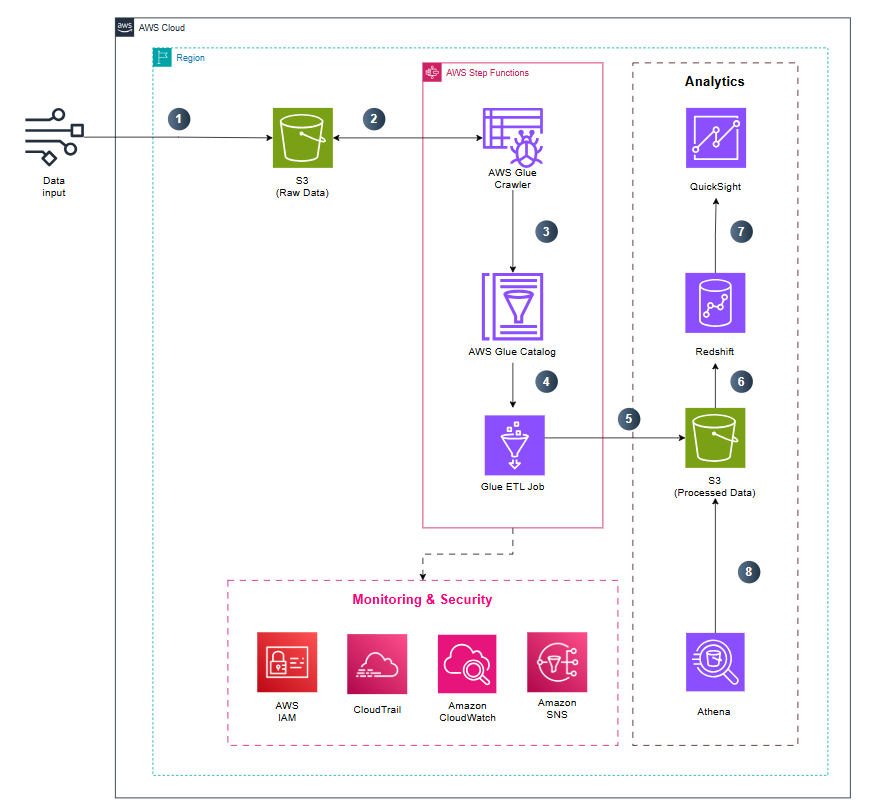
The system architecture follows the processing flow:
Raw → Metadata & ETL Processing → Analytics → Visualization.
Technical Workflow Overview:
- Ingestion: Input datasets (CSV/Parquet) are uploaded into the Amazon S3 Raw Bucket.
- Schema Crawling: AWS Glue Crawler scans raw datasets to detect schema and metadata.
- Metadata Management: AWS Glue Data Catalog stores metadata used for ETL processing and analytical query engines.
- ETL Processing: AWS Glue ETL Job performs:
- Data Cleaning
- Data Type Standardization
- Missing Value Handling
- Outlier Removal
- Feature Engineering
- Processed Storage: Cleaned datasets are stored in the Amazon S3 Processed Bucket in Parquet format.
- Data Warehousing: Amazon Redshift loads processed datasets from S3 for OLAP and analytical workloads.
- Visualization: Amazon QuickSight connects to Amazon Redshift to create business intelligence dashboards.
- Ad-hoc Query: Amazon Athena supports direct SQL queries on processed datasets stored in S3.
Technology Stack:
| Layer | AWS Service | Purpose / Role |
|---|---|---|
| Storage / Data Lake | Amazon S3 | Store Raw Data and Processed Data |
| Workflow Orchestration | AWS Step Functions | Orchestrate the data processing workflow |
| Metadata Management | AWS Glue Crawler, AWS Glue Data Catalog | Manage schema and metadata |
| Data Processing (ETL) | AWS Glue ETL Job | ETL and data transformation |
| Query Engine | Amazon Athena | Direct SQL querying on S3 |
| Data Warehouse | Amazon Redshift | OLAP Data Warehouse |
| BI / Visualization | Amazon QuickSight | Dashboards and business reports |
| Security & Monitoring | IAM, CloudTrail, CloudWatch, SNS | Monitoring, logging, and alerting |
Workflow Overview
Step 1 — Data Ingestion:
- Input datasets are uploaded into the Amazon S3 Raw Bucket.
Step 2 — Schema Crawling:
- AWS Glue Crawler scans datasets to detect schema and metadata.
Step 3 — Metadata Management:
- AWS Glue Data Catalog stores metadata used for ETL and query engines.
Step 4 — ETL Processing:
- AWS Glue ETL Job performs:
- Data Cleaning
- Schema Transformation
- Missing Value Handling
- Outlier Removal
- Feature Engineering
- AWS Glue ETL Job performs:
Step 5 — Processed Storage:
- Processed datasets are stored in the Amazon S3 Processed Bucket in Parquet format.
Step 6 — Data Warehousing:
- Amazon Redshift loads datasets from the S3 Processed Bucket for analytical workloads.
Step 7 — Visualization:
- Amazon QuickSight connects to Redshift to create business intelligence dashboards.
Step 8 — Ad-hoc Query:
- Amazon Athena supports direct SQL querying on processed datasets stored in S3.
Cost Estimation Model
The system uses a Pay-as-you-go pricing model to optimize operational costs.
Deployment region:
us-east-2
Estimated weekly cost allocation:
| AWS Service | Weekly Cost |
|---|---|
| Amazon S3 | $1.50 |
| AWS Step Functions | $0.15 |
| AWS Glue (Crawler + ETL Job) | $8.00 |
| Amazon Athena | $0.50 |
| Amazon Redshift | $11.00 |
| Amazon QuickSight | $8.00 |
| IAM, CloudTrail, CloudWatch, SNS | $1.00 |
| Total | $30.15 |